Oats: health benefits, nutrition, forms and safe use
A food-first guide to oat nutrition, beta-glucan and cholesterol evidence, processing, blood-sugar context, gluten cross-contact, herbal preparations and colloidal oatmeal.
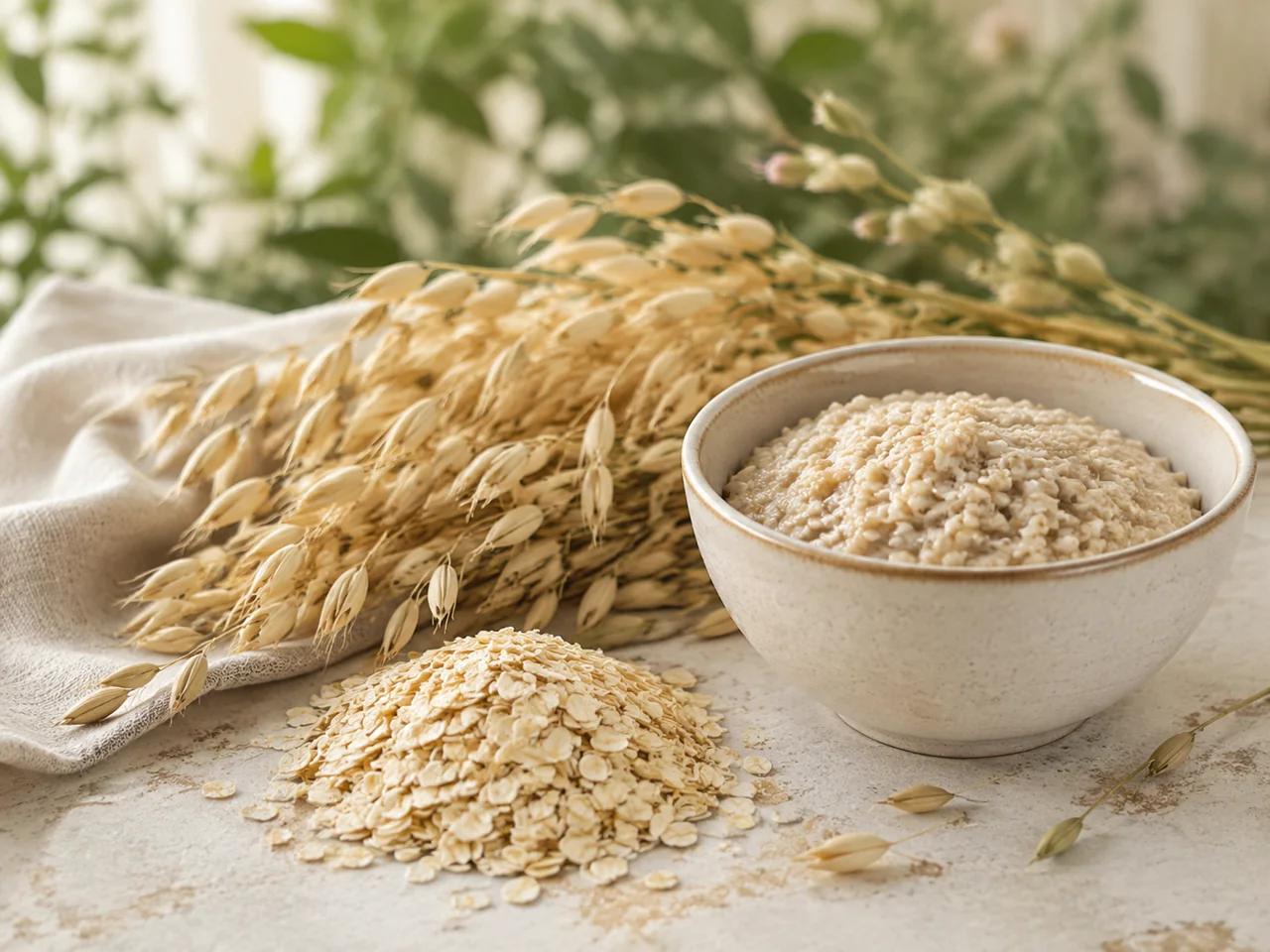
Oats are a whole-grain food with useful fiber and a particularly well-studied soluble fiber called beta-glucan. Their strongest supported health role is in cholesterol-conscious eating; other questions require attention to the oat form, serving, preparation and the person eating it.
What are oats?
Oats are the edible grains of Avena sativa. After the inedible hull is removed, the remaining groat may be sold whole, cut into steel-cut oats, steamed and flattened into rolled oats, processed more finely into instant oats, or separated into oat bran. These are related foods, but they do not have identical texture, cooking time or physiological effects.
Oats nutrition facts for rolled oats
A 40 g dry reference portion of USDA whole-grain old-fashioned rolled oats provides about 153 calories, 27.5 g carbohydrate, 4.2 g dietary fiber, 5.4 g protein and 2.4 g fat. These values describe this reference food, not every oatmeal packet, flavored product, oat-bran serving, tincture or topical preparation.
What is oat beta-glucan?
Beta-glucan is a viscous soluble fiber found in oats and barley. In the digestive tract, viscosity is part of the mechanism associated with reduced cholesterol absorption and changes in bile-acid handling. Product processing and the amount consumed influence the effect, which is why a generic bowl of oatmeal should not be assigned a guaranteed clinical outcome.
Oats and cholesterol: where the evidence is strongest
Systematic reviews of randomized controlled trials consistently report modest reductions in LDL and total cholesterol with oat beta-glucan. U.S. food-labeling rules permit a qualified relationship between soluble fiber from eligible whole-oat foods and reduced coronary-heart-disease risk when the complete dietary conditions are met. Oats support a dietary pattern; they do not replace prescribed cholesterol treatment.
Oats and blood sugar
The blood-glucose response to oats varies with particle size, cooking, portion and the rest of the meal. Groats and steel-cut oats are less processed than instant oats, but individual responses still vary. People managing diabetes should use product-specific nutrition information and their clinician’s or dietitian’s guidance rather than treating every oat product as equivalent.
Are oats gluten-free?
Oats do not contain wheat gluten, but cross-contact with wheat, barley and rye is common during growing and processing. NIDDK advises people with celiac disease who choose oats to use gluten-free oats and discuss amount and tolerance with a clinician or registered dietitian. A gluten-free label is more meaningful than an assumption based only on the ingredient name.
Oat straw, milky oats and herbal practice
Oat straw infusions and milky-oat tinctures belong to Western herbal practice. Their traditional “nourishing” or restorative descriptions should not be transferred to oatmeal, nor should food research be used as proof for tinctures. These preparations need their own evidence, sourcing and safety review.
Colloidal oatmeal is a separate topical preparation
Colloidal oatmeal is finely processed and formulated for application to skin. FDA’s skin-protectant monograph recognizes colloidal oatmeal in appropriately formulated over-the-counter products and specifies labeling and directions. Ordinary breakfast oats are not automatically an equivalent topical product.